Teacher Demonstration
Use the live model as a shared screen demonstration before students try their own predictions and observations.
Explore Static And Kinetic Frictional Model For Primary School Science Inquiry as an interactive EJS simulation for mechanics.
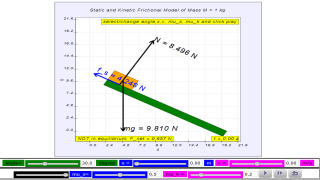
Use the live model as a shared screen demonstration before students try their own predictions and observations.
Open the simulation, adjust the controls, and compare what changes on screen before answering the concept-check questions.
At what point does the object change from staying at rest to slipping, and what force evidence shows that transition?
Before changing the applied force, predict whether the block will stay at rest or slide.
Raise the applied force in small steps and watch how friction responds before motion begins.
Once sliding begins, compare the friction value and acceleration with the just-before-slipping case.
Use the difference between applied force and friction to explain the observed motion.
Use this as a threshold lesson: students should see static friction as adjustable, not as a fixed force.
Ask: Why can friction increase while the block remains stationary? What changes when the block starts moving? How does resultant force explain the velocity graph?
Have students mark three moments: below limiting friction, at the threshold, and after sliding. Require a free-body diagram for each.
These questions are generated from the topic and the concept illustrated by the simulation. Use them after students have explored the model.
Correct first attempts build a streak and unlock higher point multipliers on this device.
1. What happens to static friction as a small applied force is increased but the block remains at rest?
2. When does the block begin to slip?
3. Once the block is sliding, which friction model usually applies?
4. Which quantity best explains whether the sliding block accelerates?
5. Why is a free-body diagram useful here?
Unlocks after 3 correct concept-check answers on this page.
1. A block remains at rest while the applied force is slowly increased from 1 N to 5 N. What is friction doing before the block slips?
2. A block starts sliding only after the applied force exceeds 12 N. What does 12 N most likely represent?
3. Why can a sliding block accelerate even though friction acts on it?
4. If the normal reaction is doubled while the coefficient of friction is unchanged, what happens to maximum static friction?
5. A student says a rougher surface always means a larger acceleration. What is the best feedback?
Anonymous activity shows this resource is being discovered, revisited, and used by learners in different places.
Country or region is inferred anonymously from server location headers when available. No names, accounts, or IP addresses are shown.