Teacher Demonstration
Use the live model as a shared screen demonstration before students try their own predictions and observations.
Explore Projectile Motion Model With Energies Graph For Primary Science as an interactive EJS simulation for mechanics.
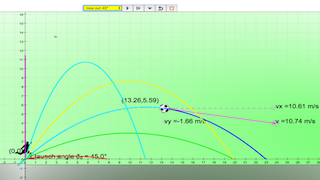
Use the live model as a shared screen demonstration before students try their own predictions and observations.
Open the simulation, adjust the controls, and compare what changes on screen before answering the concept-check questions.
Where has the mechanical energy moved between the two moments being compared?
Select a clear before-and-after pair such as top and bottom, before and after a bounce, or before and after maximum stretch.
Use speed, height, stretch, or rebound height as the visible evidence.
Identify gravitational, kinetic, elastic, or thermal stores that fit the observation.
Explain whether energy is conserved within the chosen system or transferred out by losses.
Use this as an energy-accounting task anchored to real motion. Students should compare two moments rather than describe the whole video loosely.
Ask: Where is speed greatest? Where is height greatest? Is there stretch or bounce evidence? What store gained energy?
Have students annotate two frames with energy-store labels, then write a conservation or transfer statement.
These questions are generated from the topic and the concept illustrated by the simulation. Use them after students have explored the model.
Correct first attempts build a streak and unlock higher point multipliers on this device.
1. What evidence suggests high kinetic energy in a motion video?
2. What energy store is associated with height?
3. If a bounce returns to a lower height, what should students discuss?
4. Why compare two moments?
5. What makes the conclusion strong?
Unlocks after 3 correct concept-check answers on this page.
1. In a bungee, basketball, or roller-coaster energy model, what is the best expert evidence for energy transfer?
2. At the lowest point of an ideal roller-coaster track, what should students usually check?
3. In a bungee model, why can speed be zero at a low turning point while force is not zero?
4. What is the expert critique of 'energy is lost because the ball does not reach the same height'?
5. When comparing two launches or drops, what should the student change first?
Anonymous activity shows this resource is being discovered, revisited, and used by learners in different places.
Country or region is inferred anonymously from server location headers when available. No names, accounts, or IP addresses are shown.