Ke,Pe,Te Vs T Simulator
Explore Ke,Pe,Te Vs T Simulator as an interactive EJS simulation for mechanics.
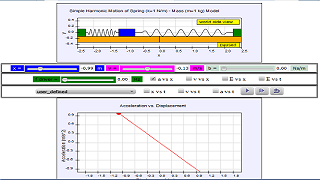
1. Watch or Launch
Launch the Interactive
Open the simulation, adjust the controls, and compare what changes on screen before answering the concept-check questions.
2. Big Ideas
What Students Can Learn
- Identify the equilibrium position.
- Use graph peaks or repeated positions to measure period.
- Distinguish displacement, velocity, and acceleration during the cycle.
- Recognise damping if the amplitude decreases over time.
Guiding Question
How do displacement, velocity, and amplitude change during each oscillation?
3. Try the Investigation
Find Equilibrium
Locate the central position about which the object oscillates.
Mark Extremes
Identify maximum displacement frames where the object turns around.
Compare Cycles
Use repeated positions or graph peaks to estimate period and amplitude.
Check for Damping
Look for shrinking amplitude across cycles and explain energy loss if present.
4. Teacher Notes
Lesson Use
Use this to target the misconception that zero velocity means zero acceleration. At maximum displacement the restoring acceleration can be large.
Discussion Prompts
Ask: Where is speed greatest? Where is displacement greatest? Does amplitude stay constant or decay?
Teaching Moves
Have students label equilibrium, amplitude, period, and one graph feature that supports each label.
5. Concept Check
These questions are generated from the topic and the concept illustrated by the simulation. Use them after students have explored the model.
Concept Score
Correct first attempts build a streak and unlock higher point multipliers on this device.
1. Where is speed greatest in ideal spring SHM?
2. What is amplitude?
3. What does decreasing amplitude suggest?
4. What does one period measure?
5. What evidence should a conclusion use?
Expert Challenge
Unlocks after 3 correct concept-check answers on this page.
1. What should an expert SHM answer identify in the interactive?
2. What is the best feedback for 'at the endpoint, acceleration is zero because velocity is zero'?
3. How should students compare two SHM runs fairly?
4. What does damping or friction do when included in an oscillation model?
5. What makes the final oscillation conclusion expert-level?
7. Learning Pulse
Anonymous activity shows this resource is being discovered, revisited, and used by learners in different places.
Where Recent Learners Are From
Country or region is inferred anonymously from server location headers when available. No names, accounts, or IP addresses are shown.